Research Thrust I: Harnessing Graph Neural Networks with State-of-the-Art Concepts for Characterization and Management of Multi-Morbidity
Traditional healthcare analytics often struggle to capture the complex relationships between patients and their chronic conditions. This research thrust investigates Graph Neural Networks (GNNs) as a novel approach to address this challenge, incorporating cutting-edge advancements in the field. Our approach leverages the inherent structure of healthcare data represented as a graph, where nodes represent patients and diseases, and edges capture their relationships. By incorporating this structural information, GNNs effectively learn latent representations of patients, capturing the influence of their co-existing conditions on future health outcomes. We specifically exploit state-of-the-art concepts such as:
-
Attention mechanisms: These mechanisms allow the model to focus on the most relevant relationships between patients and their co-existing conditions, leading to more accurate predictions.
-
Temporal GNNs: We explore modeling the dynamic nature of chronic diseases by incorporating temporal information into the graph structure, enabling predictions that evolve.
-
Explainable AI techniques: We integrate interpretability methods to understand how the network structure and patient interactions contribute to disease development, supporting informed clinical decisions.
Key contributions:
-
Improved predictive performance: Our research demonstrates significant advancements in accuracy and robustness compared to traditional methods for predicting multiple chronic conditions.
-
Enhanced interpretability: GNNs provide valuable insights into how the network structure and patient interactions influence disease development, aiding in clinical decision-making.
-
Pioneering application: This research establishes a strong foundation for utilizing GNNs in healthcare analytics, paving the way for further exploration of their potential in extracting meaningful knowledge from complex medical datasets.
Overall, this research thrust holds significant promise for revolutionizing predictive modeling in chronic disease management, ultimately contributing to improved patient care and healthcare outcomes.

Research Thrust II: Sample-Efficient Learning and Optimization of Complex Systems
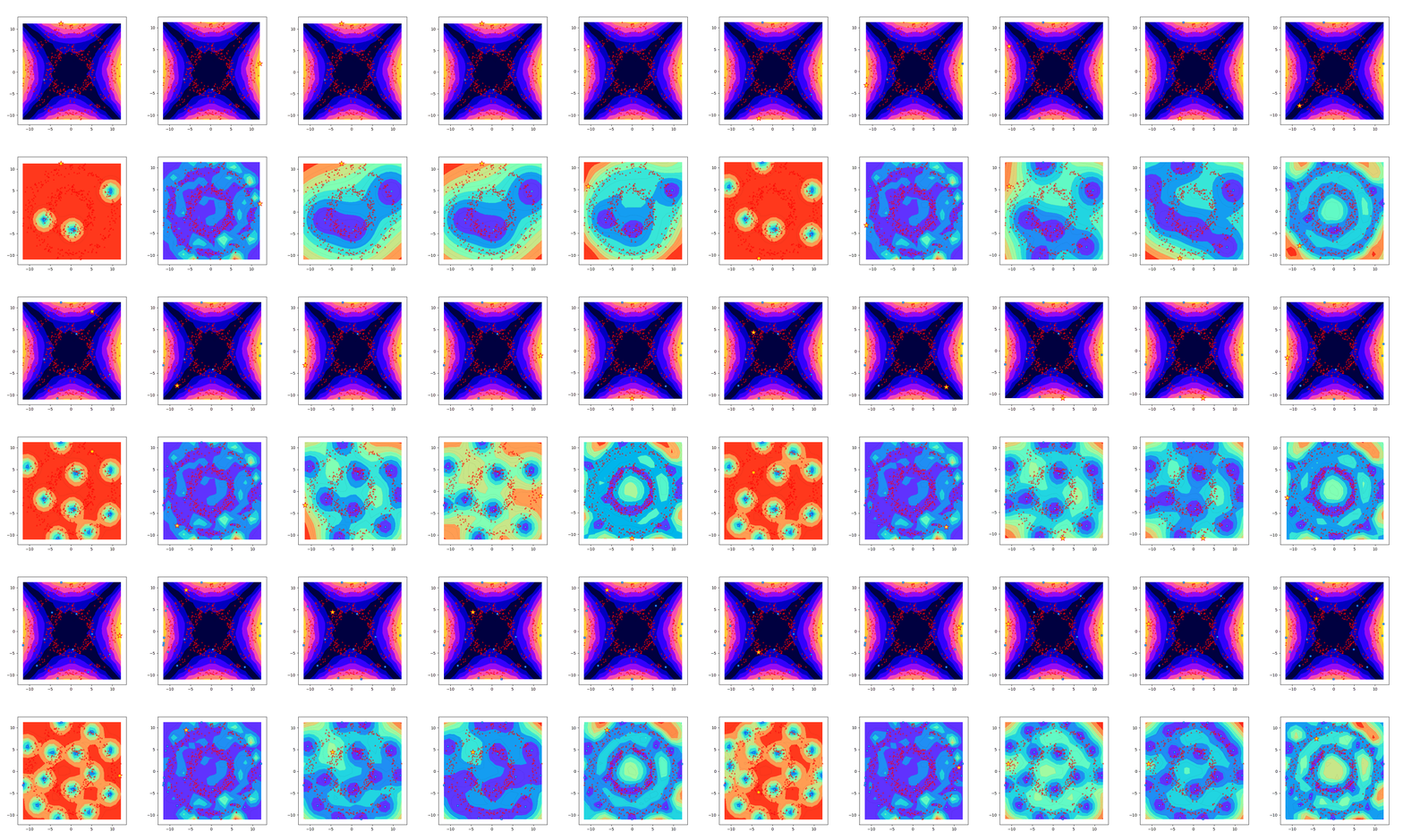
Estimating response surfaces in complex systems often involves evaluating numerous factors through expensive experiments. Traditional approaches require testing all possible factor combinations, which can be prohibitively expensive for complex systems with many factors. This research thrust investigates active learning methodologies combined with state-of-the-art Shallow and Deep Gaussian Processes to minimize the number of experiments required for accurate estimation, reducing the overall cost.
Key Contribution:
-
Novel Feature Extraction: Shifting from using manifold information as a regularizer to leveraging it as data-driven features for covariance functions. This avoids computationally expensive matrix inversions associated with Laplacian regularization methods.Adaptive Feature Extraction: Incorporates an analytical formulation for parameter initialization, enabling efficient feature extraction during the optimization process.
-
Adaptive Feature Extraction: Incorporates an analytical formulation for parameter initialization, enabling efficient feature extraction during the optimization process.
-
Gradient-Directed Bilateral Kernels: Developing a novel graph Laplacian framework based on the information of both input and output for improved similarity and manifold learning.
-
This research thrust holds significant promise for optimizing expensive tests in various domains, enabling efficient and cost-effective analysis of complex systems.
GP
SLRD
Kriging
KBAR, Variant 1
KBAR, Variant 2
Research Thrust III: Physics-Informed Reduced-Order Modeling for Streamlined Engineering Design and Manufacturing
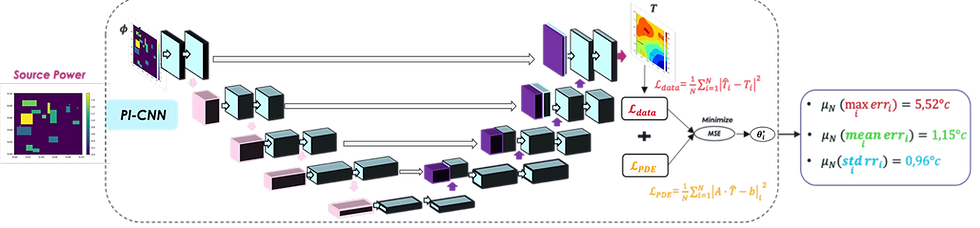
Traditional finite element method (FEM) simulations, while highly accurate, are often too slow and computationally expensive for the fast-paced demands of modern design and manufacturing workflows. This research thrust focuses on the development of physics-informed neural reduced-order models (ROMs) that provide near-instantaneous predictions of steady-state thermal performance. These models enable rapid design iterations and accelerate the entire engineering process—from concept to production.
Key Contribution:
-
Real-Time Inference: Delivers predictions orders of magnitude faster than conventional FEM, enabling real-time, interactive design iterations.
-
Optimized Accuracy–Efficiency Balance: Demonstrates that the proposed ROMs—particularly when conditioned on boundary conditions—achieve FEM-like accuracy while retaining exceptional computational speed.
-
Physics-Guided Data Generation Pipeline: Integrates deterministic PDE solvers with machine learning, ensuring that the surrogate models are physically consistent and generalizable across a wide range of design scenarios.
-
Actionable Design Insights: Generates gradient-based saliency maps that highlight the most influential regions in the design space, offering engineers clear guidance for component placement and refinement.
This research thrust holds significant promise for optimizing design and engineering for manufacturing.
Research Thrust IV: Multi-Modal Forecasting of Leeway Object Drift Using Physics-Guided AI
Accurately predicting the drift of leeway objects in maritime environments is essential for time-sensitive operations like search and rescue. This thrust introduces a novel multi-modal framework that fuses physics-informed learning with language-model-inspired architectures to forecast object trajectories under complex environmental conditions.
We combine Navier–Stokes-based simulations and convolutional neural networks (CNNs) to estimate object-specific hydrodynamic coefficients. These are integrated with experimentally measured temporal data (forces, velocities, environmental factors) and semantic metadata (e.g., object descriptions) encoded via sentence transformers. An attention-based sequence-to-sequence model then forecasts multi-horizon trajectories (1s, 3s, 5s, 10s), offering superior adaptability and forecasting depth compared to conventional physics-only or data-only methods.
Key Contribution:
-
Physics-Guided Multi-Modal Learning: Blends hydrodynamic simulations, image-based CNNs, and text embeddings for robust trajectory forecasting.
-
Real-Time Drift Prediction: Enables rapid and accurate drift forecasts across multiple time horizons.
-
Enhanced Generalization: Demonstrates strong performance across diverse object types and environmental conditions.

Research Thrust V: Integrating Wide & Deep Neural Networks With Squeeze-and-Excitation for Multi-Target Property Prediction in Additively Manufactured Fiber Reinforced Composites
Accurately predicting the mechanical and economic properties of additively manufactured (AM) fiber-reinforced composites remains a key challenge due to the complex, nonlinear interactions among process parameters. This research thrust introduces a Wide & Deep Neural Network (WDNN) enhanced with Squeeze-and-Excitation (SE) modules to address this challenge by modeling high-dimensional design space and improving predictive generalization.
Our approach leverages 155 experimentally manufactured specimens—each with varying plastic matrices, fiber types, fill densities, reinforcement configurations, and orientations. We employ Latin Hypercube Sampling to effectively sample the high-dimensional design space (4,320 combinations), enabling broad yet efficient coverage. The WDNN model combines one-hot encoded wide features with embedded deep representations and reweights them using SE blocks for dynamic feature importance adaptation. The model is trained to simultaneously predict eight targets, including Young’s modulus, yield strength, toughness, strain at break, tensile strength, weight, build time, and material cost. We specifically exploit state-of-the-art concepts such as:
-
Feature recalibration (SE blocks): These layers adaptively reweight hidden features to emphasize the most informative aspects of the input, improving model focus on relevant manufacturing parameters.
-
Wide-and-deep fusion: The model combines high-level feature abstraction with memorization of sparse interactions for multi-target regression.
-
SHAP-based interpretability: We utilize SHAP to quantify the importance of each process parameter for each predicted property, offering insights for optimal design strategies.
Key contributions:
-
High prediction accuracy: Our SE-enhanced WDNN achieved the lowest overall error (MAPE = 12.33%) across eight properties, outperforming FNN, CatBoost, XGBoost, Random Forest, and Kolmogorov–Arnold Networks.
-
Scalable design exploration: Using Latin Hypercube Sampling and UMAP, we ensure diverse yet efficient sampling of manufacturing configurations.
-
Model explainability: SHAP analysis reveals that reinforcement type, fiber orientation, and number of fiber layers dominate predictive influence, guiding future material optimization efforts.

Research Thrust VI: Integrating Artificial Intelligence and Digital Twin Technologies for Modeling and Optimization in Clean Energy Systems
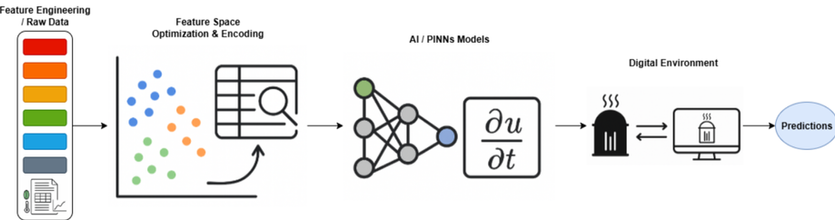
Advancements in clean energy research increasingly rely on intelligent systems that enable data-driven insights, simulation, and performance optimization. This thrust explores the integration of Artificial Intelligence (AI) and Digital Twin technologies to create smart, adaptive models for complex physical systems. Our work focuses on enhancing predictive accuracy and consistency by engineering features from experimental data, selecting suitable model architectures, and incorporating physical constraints through methods such as Physics-Informed Neural Networks (PINNs). These models aim to represent key system behaviors with high fidelity, enabling improved diagnostics, forecasting, and simulation capabilities across various clean energy applications.
Feature Space Optimization: Leveraging domain knowledge and data-driven insights to extract critical behavioral patterns.
Model Selection and Tuning: Comparative evaluation of multiple AI models to identify the most effective predictive frameworks.
Physics-Informed Modeling: Integrating physical laws into AI models to improve generalization and consistency.
Key contributions:
-
Improved predictive accuracy: Enhanced model performance, even under previously unseen operational scenarios.
-
Enhanced physical consistency: Ensuring outputs respect known physical constraints, building trust in AI predictions.
-
Transformational application: Laying the groundwork for broader AI-Digital Twin integration across energy systems.
Overall, this thrust presents a forward-looking approach to smarter, safer, and more efficient decision-making in clean energy technologies.
Research Thrust VII: An Interpretable Transfer Learning-Based Neural Network Framework for Mechanical
Design Manufacturability Evaluation and Diagnosis with Reduced Data Requirements
Designing a manufacturable component often requires either deep familiarity with manufacturing processes or constant access to manufacturing expert knowledge, and it has always been challenging for designers with limited experience or those from non-manufacturing backgrounds. To address this barrier, we proposed an interpretable, transfer learning-based neural network framework for evaluating and diagnosing the manufacturability of mechanical designs with reduced data requirements. The framework is demonstrated across three common industrial manufacturing scenarios: drilling, pocket milling, and a combined drilling–milling process. Each case is treated as a binary classification task using a modular feed-forward neural network trained sequentially with layer-wise weight transfer. Rather than relying on a single, complex model trained on heterogeneous data, the proposed method incrementally builds knowledge from simpler, well-structured subsets, achieving comparable performance with significantly less data and reduced computational overhead. The model’s behavior with respect to catastrophic forgetting, a common challenge in sequential learning where knowledge of earlier tasks is lost after training on newer tasks, is also examined. To evaluate this, we re-tested the model on the initial machining task after completing training on all three manufacturing scenarios. The minor performance degradation indicated that the model maintains a strong memory of earlier tasks, even after undergoing multiple sequential updates. This demonstrated the effectiveness of our transfer learning approach in preserving prior knowledge. We validated our method against conventional machine learning models (SVM, KNN, Random Forest, XGBoost, KAN) and a 3D convolutional neural network (3D CNN), which is commonly used in related research, and demonstrate competitive or superior results. For interpretability, we integrated SHAP analysis, UMAP visualization, and an autoencoder-based projection to provide insight into model decisions and latent structure. All datasets used in this study were synthetically generated based on real-world CAD design principles and design for manufacturability (DFM) rules. This work offers a practical and scalable framework for data-efficient manufacturability assessment and supports intelligent design guidance in engineering workflows.
Key Contribution:
-
Sequential transfer learning: This technique allows the model to incrementally build knowledge from simpler, well-structured subsets rather than relying on a single, complex model trained on heterogeneous data, which makes it expandable.
-
Catastrophic forgetting: The proposed model shows a negligible drop in classification capabilities after several steps, showing a strong capability of transferring knowledge without significant forgetting.
-
Interpretable AI techniques: We employed SHAP analysis, UMAP visualization, and a custom autoencoder to assess the significance of each design parameter in manufacturability, providing insights into model decisions and latent structures.
-
Reduced data requirement: The proposed model achieves comparable performance with significantly less data and reduced computational overhead.
This research thrust holds significant promise for design and engineering for manufacturing.

Research Thrust VIII: Operator-Theoretic Learning Framework for Predicting Battery State of Charge and Remaining Useful Life
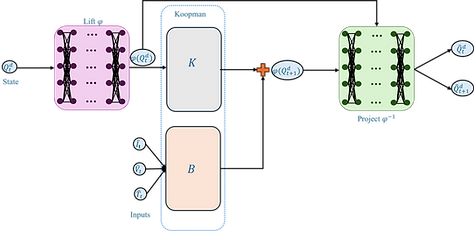
The State of Charge (SoC) and Remaining Useful Life (RUL) are vital states in lithium-ion batteries (LIBs) that are monitored to ensure their safety and operability, and thus, their accurate estimation is important. Existing approaches often focus on separately modeling one or the other and fall short in capturing the nonlinear, age-dependent degradation behaviors that influence both states. In this study, we propose a novel joint operator-theoretic deep learning framework for age-responsive estimation of SoC and RUL. The proposed model first leverages the computational capability of neural operator mapping of the input space to model the underlying discharge capacity degradation dynamics of lithium-ion batteries. This discharge capacity is applied as a dynamic correction to input features used for SoC estimation, improving robustness to aging-induced variability. The Koopman component enables linear modeling of the predicted nonlinear discharge capacity dynamics and predicts future degradation models given the current states and profile, given an estimate of the time till the end of life of the battery. This joint model, consisting of a Koopman autoencoder network and a neural operator network, learns both time-evolving degradation and spatial battery behavior in an end-to-end manner. We evaluate our framework on real-world datasets spanning different operational profiles and battery aging stages, showing its robustness while maintaining stability across aging conditions.
Key Contribution:
-
We introduce a two‐stage Fourier Neural Operator (FNO) framework, where the first stage learns the battery capacity fade, which serves as an adaptive correction to the second stage, that predicts the SOC explicitly. The capacity fade is a proxy for battery aging, letting the FNO capture the cumulative, nonlinear degradation mechanisms that classical approaches overlook.
-
Given state operational conditions at current cycle and the learned capacity fade from the first stage FNO, we implement a Koopman autoencoder to model the latent linear dynamics of degradation, allowing for multi-step forecasting of future capacity and corresponding RUL estimation.
-
We validate our trained end-to-end framework on diverse real-world LIB datasets across different aging profiles and operational modes, demonstrating its robustness and generalization capability.